

The only truly accurate answer to this question is: the best time to visit San Blas is when your schedule allows you to travel.
The San Blas Islands can be visited year-round. The climate is tropical, temperatures remain warm, and the Caribbean Sea stays warm in every season. San Blas is also outside the Caribbean’s main hurricane track, which helps make the destination accessible to travelers throughout the year.
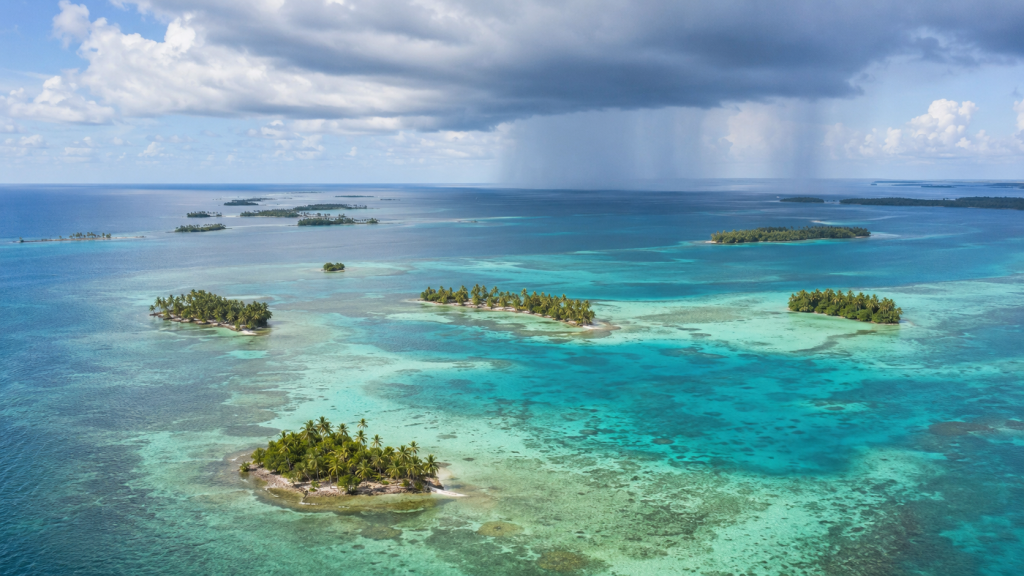
Traditionally, the region’s climate was divided into a period considered drier and another considered rainier. However, changes observed in recent years have made these patterns increasingly less predictable.
For this reason, we do not recommend choosing your travel dates based only on historical averages, weather apps, or the expectation of finding a month with no rain.
In this guide, we explain the weather in San Blas, what can actually affect your trip, and why wind, ocean currents, and sea conditions matter more than a simple rain icon in a forecast.
Can You Visit San Blas Year-Round?
Yes. San Blas is a year-round destination.
Because it is in the Caribbean, the region has a tropical climate, warm temperatures throughout the year, and comfortable sea temperatures in every month. Even on cloudy or rainy days, temperatures generally remain pleasant for enjoying the water and outdoor activities.
The region is also south of the Caribbean’s main hurricane track. Direct impacts from hurricanes are uncommon compared with destinations farther north.
This does not mean San Blas is completely isolated from the effects of distant weather systems. Cold fronts, tropical storms, and other weather changes in the Caribbean can temporarily affect winds, currents, and sea conditions.
Even so, the absence of a regular hurricane season that routinely shuts down operations means San Blas attracts travelers throughout the year.
So, What Is the Best Time to Visit San Blas?
There is no single month that can be considered the best for every traveler.
The best time is the one that works with your available dates, your Panama itinerary, and the availability of the experience you want to reserve.
Choosing a specific month does not guarantee sunshine, rain, light winds, or calm seas. Averages from previous years can help explain how the weather has historically behaved, but they cannot determine what conditions will be like during a specific future trip.
This conclusion is not based only on weather charts. We follow conditions in San Blas throughout the year and, especially in recent years, we have observed significant changes in rainfall patterns, wind, and sea stability.
Months traditionally described as dry have experienced several consecutive days of rain. Likewise, periods historically considered rainy have had weeks of abundant sunshine and excellent conditions.
For that reason, the most transparent answer is:
The best time to visit San Blas is when your schedule allows you to travel. The weather remains warm year-round, and no historical average can guarantee what conditions will be like during your trip.
What is the weather like in San Blas?
San Blas has a tropical climate. Temperatures remain warm throughout the year, humidity is high, and the Caribbean Sea stays warm.
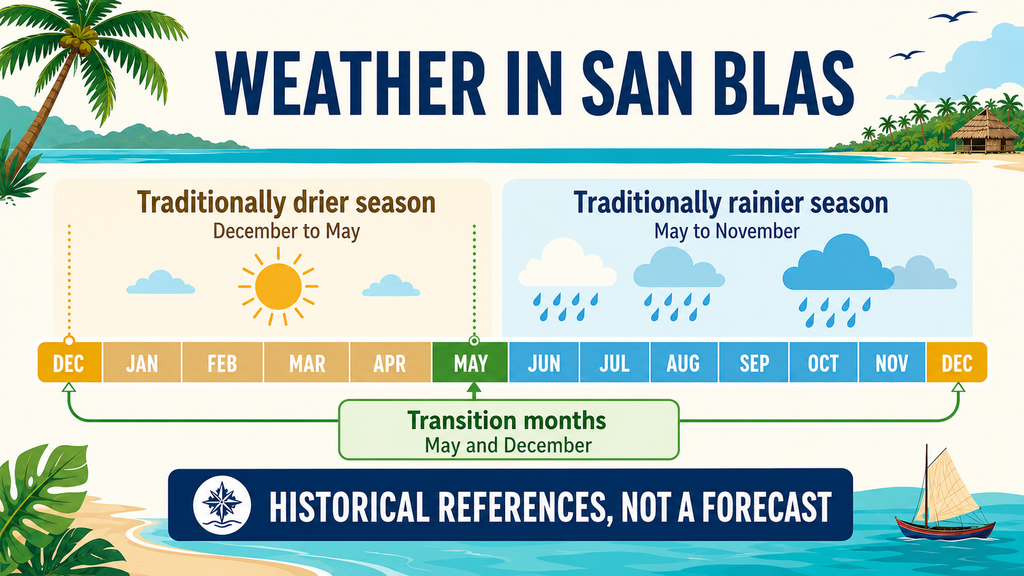
The region does not have four clearly defined seasons such as spring, summer, fall, and winter. It feels like summer year-round. Historically, two main periods have been used as references:
- A period considered drier, traditionally from December through May;
- A period considered rainier, traditionally from June through November.
May and December were traditionally described as transition months between these two periods.
These classifications can still be used as historical references, but they should not be interpreted as forecasts. Climate changes and variations observed in recent years have made these patterns less consistent.
What Happened to the Dry and Rainy Seasons?
In practice, the distinction is no longer as clear as it once was. In recent years, we have observed the following in San Blas:
- Extended rainfall in January and February, months historically considered dry;
- Long periods of sunshine during the traditionally rainier season;
- Changes in wind intensity and direction;
- Cold fronts outside expected patterns;
- Variations in currents and sea conditions;
- Less clearly defined transitions between periods of the year.
This does not mean historical patterns have completely lost their usefulness. They still help explain the region’s tropical climate, particularly in relation to tropical weather systems, but they are not enough to choose a date or predict what a specific trip will be like.
Period Traditionally Considered Drier
From December through May, rainfall was historically less frequent. However, this period can also bring stronger winds and rougher sea conditions.
A historically lower chance of rain does not mean calmer seas.
Period Traditionally Considered Rainier
From May through November, rainfall was historically more frequent. Even so, there can be many sunny days or even weeks, warm temperatures, and calm water.
A historically higher chance of rain does not mean it will rain throughout your trip. The sea also tends to be calmer during this period because winds are often lighter.
Months Traditionally Considered Transitional
May and December traditionally marked the transition between the two periods. Today, these transitions do not occur on exact dates and can vary significantly from one year to another.
Comparison of Traditional Weather Periods
| Period | Historical reference | What may happen in practice |
| December to May | Period considered drier | There may be sunshine, rain, strong winds, and rougher seas |
| May and December | Months considered transitional | Conditions may include characteristics of both periods |
| May to November | Period considered rainier | There may be rain showers, but also long periods of sunshine and lighter winds |
* This comparison is only a historical reference. It should not be used as a forecast for a specific reservation.
Is San Blas in the Hurricane Zone?
San Blas is outside the Caribbean’s main hurricane track. This is one of the reasons the destination can be visited year-round.
Direct impacts from hurricanes are uncommon in the region. However, weather systems that form elsewhere in the Caribbean or Atlantic can create indirect effects, including:
- Changes in wind direction and intensity;
- Increased wave activity and swell;
- Changes in ocean currents;
- Heavy rain for several consecutive days;
- Adjustments to navigation routes;
- Temporary suspension of transportation in exceptional situations.
Therefore, being outside the main hurricane track does not mean sea conditions remain the same throughout the year. It means San Blas does not face a regular season of operational interruptions caused by direct hurricane impacts.
Is the Weather in Panama City the Same as in San Blas?
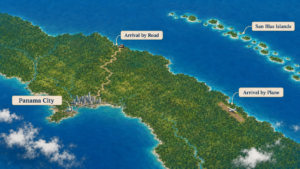
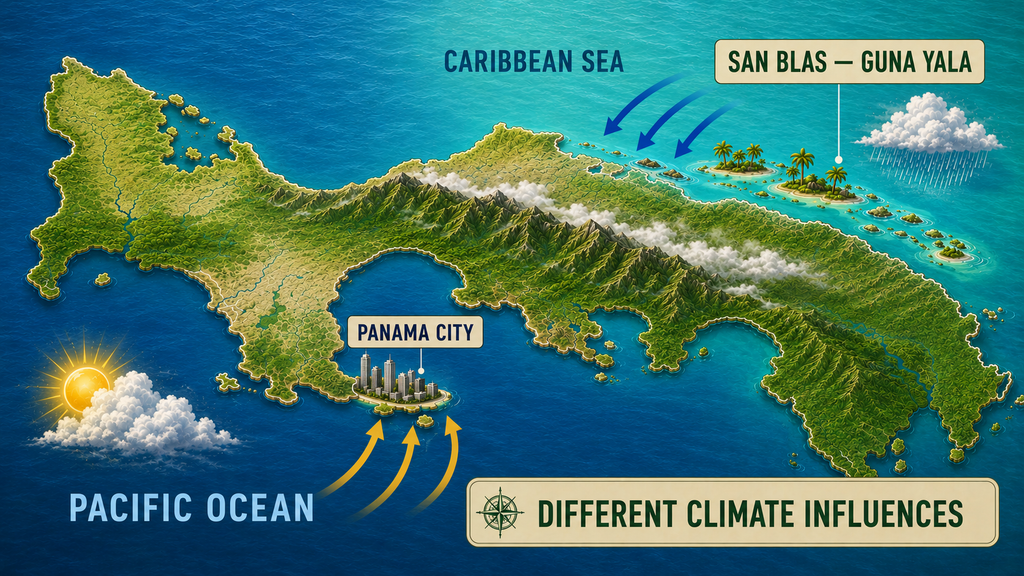
No. Panama City and San Blas are on different sides of the country and are influenced by different oceans.
Panama City faces the Pacific Ocean. San Blas is on the Caribbean coast. A mountain range between the two regions can also influence cloud movement, winds, and rainfall.
For this reason:
- It can be raining in Panama City while San Blas is sunny;
- The capital can have clear skies while it is raining on the islands;
- Winds can be light in the city and stronger in the Caribbean;
- Sea conditions in San Blas cannot be evaluated using Panama City’s forecast;
- Looking at the sky from your hotel window does not tell you what the weather will be like in the San Blas archipelago.
Panama City’s forecast should not be used to decide whether conditions are appropriate for traveling to San Blas.
Is There a Specific Weather Forecast for San Blas?
San Blas is a large archipelago made up of hundreds of islands spread across different regions. There is no local weather infrastructure that produces a detailed forecast representative of conditions across the entire archipelago.
Weather apps may use data from distant stations, regional models, or reference locations that do not correspond exactly to the area where you will be staying.
In many cases, the forecast shown on your phone may refer to Panama City, another nearby city, or a very broad area. As a result, what appears in the app often does not match what is actually happening in San Blas at that moment.
Why Does the Weather App Show Rain Every Day?
In tropical regions, weather apps often display a rain icon whenever there is any chance of precipitation during the day and across a broad area.
This does not necessarily mean it will rain:
- All day;
- On every island;
- Exactly where your accommodation is located;
- During your transfers;
- At the time of your activities;
- With the intensity shown in the forecast.
It may rain in one part of San Blas while another remains sunny. It is also possible for an app to show rain even when no precipitation occurs in the area you visit.
For this reason, the icon on your screen should be interpreted only as a possibility, not as an exact description of the day’s weather.
Can You Rely on a 10- or 15-Day Forecast?
We do not recommend making decisions based on 10- or 15-day weather forecasts for San Blas.
That far in advance, the information should be interpreted only as a regional trend. It cannot accurately tell you:
- Which part of the archipelago will receive rain;
- How long the rain might last or whether it will occur at all;
- What the wind and currents will be like;
- What sea conditions will be;
- Whether transportation will be affected;
- What conditions will be like throughout your entire experience.
Forecasts are generally more useful approximately 24 hours in advance, depending on the weather model being used. Even then, conditions can change quickly.
Does Rain Mean You Lose the Day?
No. Rain does not mean losing a day in San Blas.
The weather remains warm, the sea stays comfortable, and many activities can resume as soon as the rain passes. Isolated tropical showers often last between 40 minutes and an hour, although the duration of any individual shower cannot be guaranteed.
It is important, however, to distinguish a passing shower from a larger weather system. Some conditions can create instability for a longer period, especially when accompanied by strong winds.
Rain by itself is not the most important operational factor in San Blas.
What Can Actually Affect Your Trip?
Wind, ocean currents, and sea conditions are more important than rain.
These factors can directly affect:
- Speedboat transfers;
- Catamaran navigation;
- Anchorages;
- Going ashore on the islands;
- Water activities;
- Traveler comfort;
- The continuity of operations.
A passing shower usually ends relatively quickly. Strong winds, waves, and unfavorable currents, on the other hand, can continue for several hours.
For this reason, a sunny day does not necessarily mean the sea will be calm. Likewise, a rain icon in an app does not mean transportation will be suspended.
Transportation is not usually suspended because of rain alone. Operations may be interrupted when wind, waves, currents, or a storm make road travel or navigation from the port to the reserved accommodation unsafe or impractical.
Who Decides Whether Conditions Are Safe?
Operational decisions are made by the people responsible for each stage of the trip, based on actual conditions and guidance from the authorities. During ground transportation, at the port, in the speedboat, and aboard the catamaran, passengers must follow instructions from the operator, driver, crew, and captain responsible.
Before and during the experience, factors evaluated include:
- Wind speed and direction;
- Wave height and behavior;
- Ocean currents;
- Official alerts;
- Conditions at ports and navigation channels;
- Information provided by local operators;
- Weather systems that may affect the region.
Safety always takes priority over a planned itinerary. When necessary, schedules, activities, transportation, or the regions visited may be adjusted.
When Is San Blas Most in Demand?
San Blas receives travelers year-round. However, demand increases during vacation periods and holidays, not necessarily because those dates guarantee better weather.
The highest-demand periods include:
- Christmas and New Year’s;
- Carnival;
- Easter and Holy Week;
- Northern Hemisphere summer vacations, especially July and August;
- National and international holidays.
During these dates, catamarans, bungalows, and transportation may have limited availability. We recommend booking in advance, especially for families or groups with specific needs.
Is There a Low Season in San Blas?
We do not define a low season based on weather.
San Blas is visited year-round, and rates generally remain the same regardless of the month. The traditional distinction between dry and rainy seasons does not automatically result in lower prices.
The main exceptions are special periods:
- Carnival;
- Easter and Holy Week;
- Christmas and New Year’s, approximately December 20 through January 10.
During these dates, rates increase according to the conditions established by each catamaran or bungalow.
Outside these periods, rates remain unchanged.
How Should You Choose Your Travel Dates?
Choose your dates based on your actual availability, your Panama itinerary, and the availability of the experience you want to reserve.
We do not recommend reorganizing your entire trip to chase a supposedly perfect month, because no period can guarantee sunshine or an absence of rain.
Before booking, consider:
- The dates when you can actually travel;
- Availability of catamarans or bungalows;
- The length of your experience;
- Holidays and high-demand periods;
- Your flexibility if the experience date needs to change;
- Your sensitivity to motion at sea;
- Your group’s specific needs.
Choosing the right accommodation and aligning traveler expectations with what the destination actually offers usually has a greater impact on the experience than trying to predict the weather months in advance.
How Should You Prepare for Any Time of Year?
Regardless of your travel dates, we recommend bringing:
- Sunscreen;
- Hat or cap;
- Sunglasses;
- UV-protection shirt or rash guard;
- Lightweight, quick-drying clothing;
- A lightweight rain jacket;
- A waterproof bag;
- Waterproof protection for documents and electronics;
- Insect repellent, especially for island stays;
- Personal medications;
- A lightweight layer or windbreaker;
- Simple footwear suitable for boarding and going ashore.
We also recommend purchasing travel insurance and avoiding flights scheduled immediately after leaving San Blas. In a remote destination, changes to planned timing can occur and are normally outside the control of the catamaran, accommodation, and transportation company.
No Time of Year Guarantees Sunshine Every Day
No catamaran, bungalow, or travel company can guarantee the weather.
Photos and videos posted on social media capture specific moments. They do not necessarily represent the conditions you will encounter on a future date.
Likewise, historical averages explain how weather behaved in the past, but they do not determine what conditions will be like in the future.
When planning your trip, it is important to understand that:
- It can rain during a historically drier period;
- It can be sunny during a historically rainier period;
- Normal rain does not mean losing the day;
- Temperatures and sea temperatures remain warm;
- Conditions can change quickly;
- Safety is non-negotiable;
- Flexibility should be part of the experience.
So, When Should You Travel to San Blas?
Travel when your schedule allows.
San Blas remains warm, tropical, and beautiful year-round. There is no single month that can guarantee sunshine, no rain, or completely calm seas.
At San Blas Shared, we help our travelers compare shared catamarans and bungalows based on the group’s profile, the amenities and setup offered, available dates, and each traveler’s expectations.
More important than trying to find a perfect forecast is choosing the right option and traveling with a clear understanding of the realities of a remote Caribbean destination.
Already Have Dates in Mind?
Explore the available options and tell us about the travelers in your group so we can help guide your choice.